
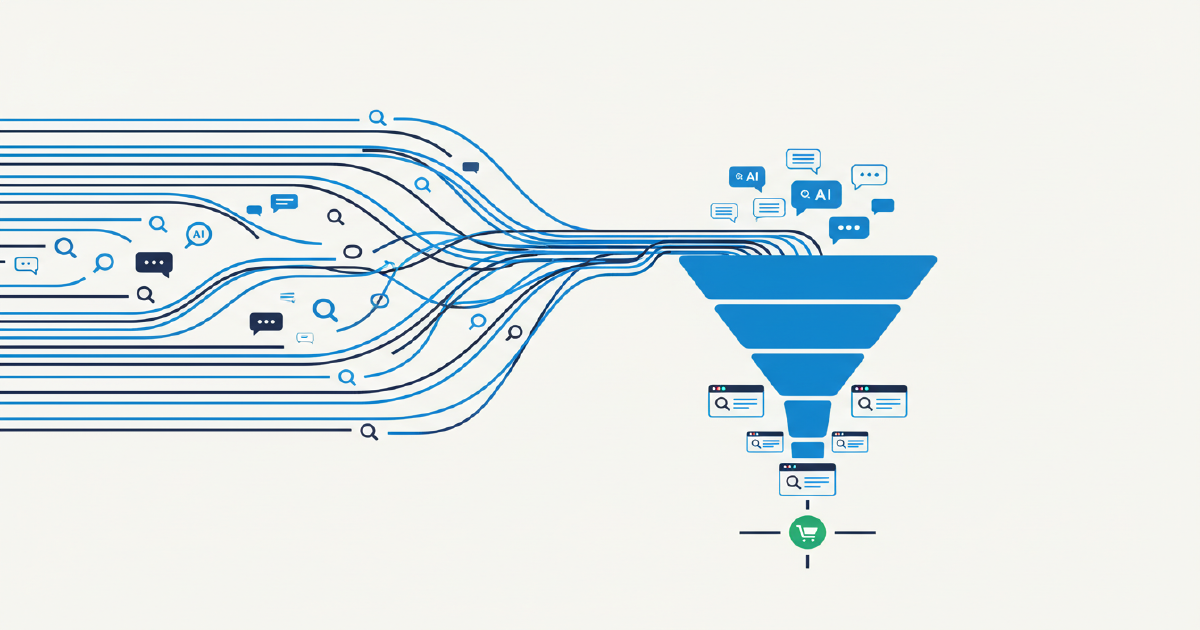
The Thesis
AI channel visitor sessions from ChatGPT, Gemini, and Copilot are not driving direct e-commerce purchases at high rates, for the moment. Instead they’re functioning as mid-funnel research tools: a place where consumers validate a purchase decision they’re already considering, before returning to a familiar channel to buy.
This analysis is based on data from a direct-to-consumer e-commerce brand over a 48-day period, using full multi-channel attribution across every session for visitors who interacted with AI at any point in their journey.
This is one data point from one anonymized Shopify brand. We’re sharing it to give directional data where very little exists today, to encourage more information sharing across the industry, and to bring new data to the table for critique and discussion. Your results will vary.
AI Involvement Correlates With Higher Purchase Intent
Conversion rates split sharply based on whether AI was part of a multi-channel journey or the only touchpoint:
| Journey Type | Conversion Multiple (vs. Site Avg) |
|---|---|
| AI + other channels | 14.2x |
| AI only | 2x |
AI involvement correlates with higher purchase intent, but AI alone doesn’t close the sale. Users who reach a brand through AI are already deeper in a buying decision. AI is part of their research process, not their purchase process.
On correlation vs causation: The data shows visitors who use AI alongside other channels are also heavier site users in general. The higher conversion multiple reflects research-intensive purchase behavior, not necessarily AI causing conversions. What the data shows confidently is that AI is part of the toolkit high-intent buyers are using.
Where AI Reserach Sits in the Journey for Users
| AI Position in Journey | Share of AI-Research Purchasers | Conversion Rate Lift |
|---|---|---|
| Same-visit conversion Arrived from AI and bought in that session |
67.7% | AI only (2x site avg) |
| Mid-funnel research Visited the site first, consulted AI, then returned to buy |
22.6% | AI + other channels (14.2x site avg) |
| Post-sale research Consulted AI only after purchasing |
6.5% | N/A |
The dominant pattern is direct conversion: most real users who arrive from an AI chatbot and eventually buy do so in that same session. The mid-funnel research cohort, users who visit the site, go research in AI, then return to buy, represents about a quarter of AI-touched purchasers.
The Research Loop: Search, AI, Search, Purchase
The dominant journey pattern shows users bouncing between search engines and AI chatbots before purchasing:
| Referral Path | Frequency |
|---|---|
| Organic Search → AI Chat → Organic Search → Purchase | Most common |
| Organic Search → AI Chat → Paid Search → Purchase | Common |
| Paid Search → AI Chat → Organic Search → Purchase | Common |
| Social → AI Chat → Social → Purchase | Notable |
What Channels Feed Into AI Research?
| Channel Before AI Session | Share |
|---|---|
| Organic Search | ~39% |
| Direct | ~24% |
| Paid Search | ~15% |
| Referral | ~7% |
| Social | ~4% |
The channel a user was on immediately before their AI session. If someone clicked a Google result, browsed your site, then opened ChatGPT to ask about your product, that session’s feed-in channel is Organic Search.
What Channels Do Users Go To After AI Research?
| Channel After AI Session | Share |
|---|---|
| Organic Search | ~50% |
| Paid Search | ~22% |
| Referral | ~10% |
| Social | ~6% |
The first channel a user returned to after leaving their AI session. If someone asked ChatGPT about your product, then Googled your brand name to get back to your site, that session’s after-AI channel is Organic Search.
Where AI-Touched Visitors Actually Purchase
These are visitors who used AI at some point in their journey, but this table shows which channel they were on when they actually completed their first purchase. The “last click” before the transaction:
| Purchase Channel | Share of First Conversions |
|---|---|
| Organic Search | 42.9% |
| AI (direct) | 22.4% |
| Paid Search | 17.3% |
| Referral | 9.2% |
| Social | 3.1% |
| Other | 5.1% |
About three-quarters of AI-touched visitors leave AI and complete their purchase somewhere else. Organic Search alone accounts for over 40% of final purchase clicks. In a last-click attribution model, AI gets no credit for these conversions, even though it was part of the research that led to the sale.
AI Session Behavior: Research, Not Shopping
AI-referred sessions show distinct research behavior:
65% of AI sessions involve viewing 2 or more pages, and 55% include a product page view. For comparison, product view rates by channel:
| Channel | Sessions with Product View |
|---|---|
| Paid Search | 77.7% |
| Organic Search | 72.6% |
| Social | 56.5% |
| AI Referral | 55.0% |
| Direct | 39.5% |
AI sessions have a product view rate comparable to social traffic. These users are actively researching products, not reading blog content.
Time to Purchase
For visitors who interacted with AI before purchasing:
| Time from AI to Purchase | Share |
|---|---|
| Same session | 45.3% |
| Same day | 13.2% |
| 1-3 days | 7.5% |
| 3-7 days | 9.4% |
| 1-2 weeks | 9.4% |
| 2-4 weeks | 9.4% |
Nearly half convert in the same session. The other half distributes fairly evenly across time horizons, indicating AI research informs purchases at every stage of the consideration window, from same-day decisions to multi-week evaluations.
Implications
For Attribution
Last-click attribution under-counts AI’s contribution. About three-quarters of AI-influenced purchases are credited to search or social because that’s where the user clicked last. Any attribution model that doesn’t capture the full multi-channel journey will systematically undervalue AI as a channel.
This is where the WISLR AI Visibility Dashboard fills the gap: it tracks AI’s role across the full journey, not just at the point of conversion.
For Content Strategy
AI chatbots are pulling your product pages and blog content to answer user questions. The content that performs well in AI research sessions, comparison pages, specification details, “is it worth it” content, is directly influencing purchase decisions, even when the final click comes through Google. Optimizing content for AI consumption isn’t separate from your content strategy. It is your content strategy.
For Multi-Channel Impact
AI is not cannibalizing search. It’s amplifying it. Users who consult AI are more likely to return through Organic Search (~50%) than through any other channel. AI research generates branded search queries, which has implications for both SEO and paid search strategy. Brands investing in AI visibility are likely seeing returns in their search metrics without realizing where the demand originates.
Frequently Asked Questions
Do AI chat sessions drive direct e-commerce purchases?
At very low rates. AI functions as a mid-funnel research tool, not a purchase channel.
- AI-only visitors convert at 2x the site average
- AI + other channels converts at 14.2x the site average
- ~75% of AI-touched purchases happen through a non-AI channel
- Organic search accounts for 42.9% of final purchase clicks
What is the most common referral path when AI is involved in a purchase?
The dominant pattern is Organic Search to AI Chat to Organic Search to Purchase.
- User finds the brand on Google
- Consults an AI chatbot to research the product
- Returns to Google to navigate back and buy
- After AI, organic search’s share as the next channel increases from ~39% to ~50%
- Direct traffic disappears entirely as a next step
Where do AI-touched visitors actually complete their purchase?
In a last-click model, AI gets no credit for ~75% of these conversions, even though it was part of the research.
- Organic Search: 42.9%
- AI (direct): 22.4%
- Paid Search: 17.3%
- Referral: 9.2%
- Social: 3.1%
- Other: 5.1%
How long does it take for AI-touched visitors to purchase?
AI research informs purchases at every stage of the consideration window.
- Same session: 45.3%
- Same day: 13.2%
- 1-3 days: 7.5%
- 3-7 days: 9.4%
- 1-2 weeks: 9.4%
- 2-4 weeks: 9.4%
Does AI referral traffic cannibalize organic search traffic?
No. The data shows AI amplifies organic search.
- Users who consult AI are more likely to return through organic search (~50%) than any other channel
- Organic search share increases from ~39% before AI to ~50% after AI
- AI research generates branded search queries that feed back into search
What does AI session behavior look like compared to other channels?
AI-referred visitors are actively researching products, not passively browsing.
- 65% of AI sessions involve viewing 2+ pages
- 55% include a product page view (comparable to social at 56.5%)
- Session depth: 35% bounce, 31.7% view 2-3 pages, 18.9% view 4-7 pages, 14.5% go 8+ pages deep